
 |
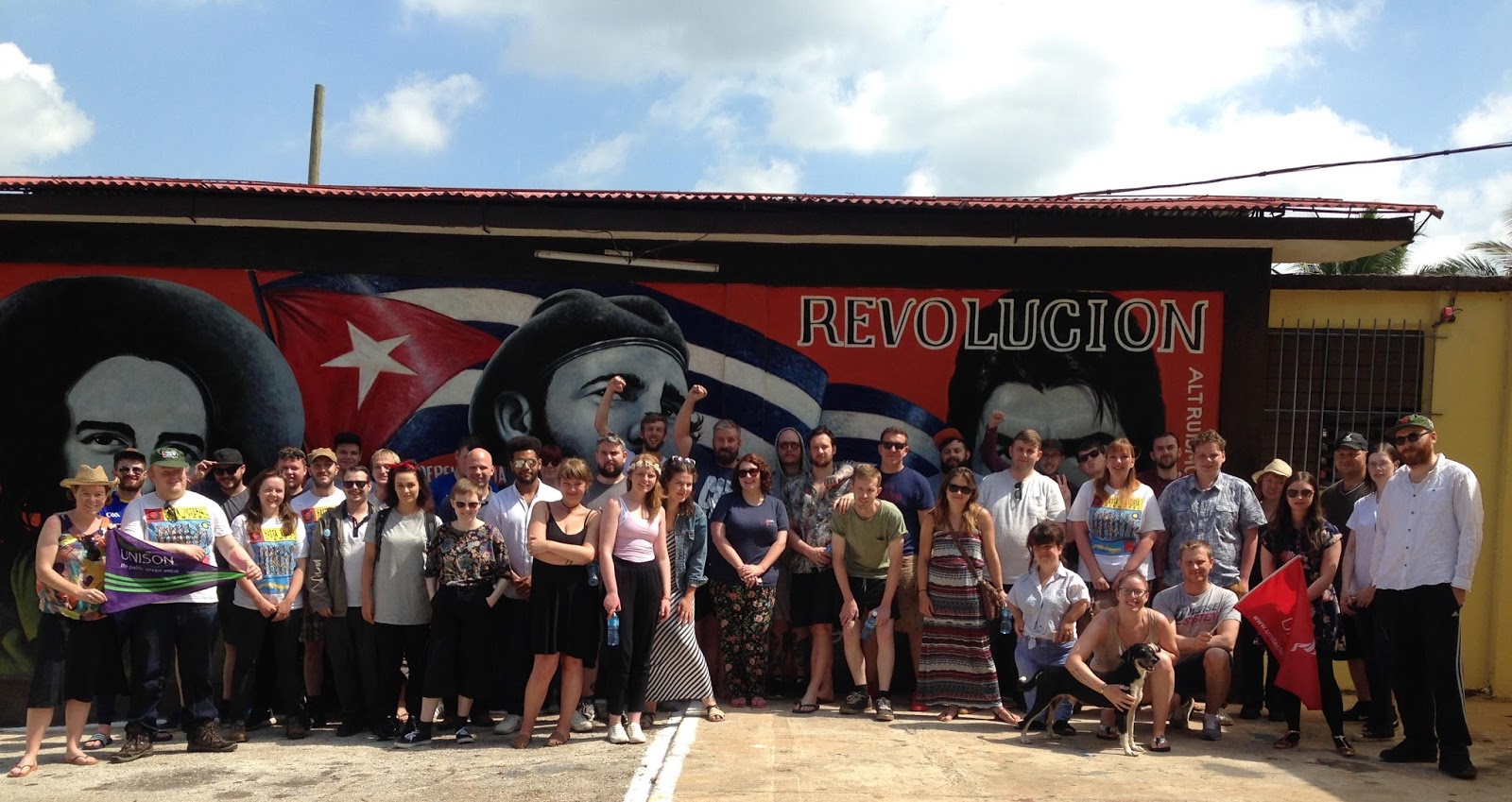
| The British and Irish 2017 May Day brigade delegation |
The largest ever CSC delegation - representing millions of workers from across the British and Irish trade union movement including delegates from Unite, UNISON, TSSA, GMB, RMT and CWU - took part in a full programme of solidarity and agricultural work, conferences, meetings, visits and exchanges with the Cuban people.
A total of 286 brigadistas from 29 countries – demonstrating the excellent range of international solidarity with Cuba – attended the brigade where they took part in solidarity work and learned how they could support Cuba’s ongoing struggle to end the illegal US blockade of the island.
The brigade was mostly spent at the Julio Antonio Mella International Camp (CIJAM) in rural Cuba,near Caimito, Artemisia province, 40km away from Havana. Conditions on the camp were basic, with shared dormitory accommodation, basic meals and cold water showers, but the delegates fully embraced the inspirational atmosphere on the camp of internationalism and solidarity.
 |
| Performing agricultural work |
All continents were represented at CIJAM, with brigadistas attending from countries including Chile, Brazil, Congo, Zambia, Switzerland, Korea, Australia, Ukraine and many more. For the first time ever, a United States delegation took part in the brigade, with 50 activists representing the US, including Black Lives Matter activists from Chicago alongside solidarity activists from Chicago, LA, Philadelphia and New York.
In addition to the opportunity to speak to Cubans about their lives and experiences under US blockade, the international camp was an excellent environment for the young members to share ideas and exchanges with trade unionists and activists from all around the world.
Delegates took part in agricultural work based locally to the camp included weeding, cutting crass, cleaning and clearing rocks and sticks. Grass was cut by hand using machetes, giving the young members a brief insight into the difficulties of agricultural work under the blockade in Cuba, as many resources are difficult to obtain.
 |
| Brick making at a co-operative in Artemisa |
The brigade visited local co-operatives in Artemisia, which are playing an increasingly significant role in Cuba’s economy. Agriculture is the largest sector in Artemisia province, and the co-operatives visited produced a variety of fruits such as coconuts and mangoes, vegetables, sugar, cattle, milk and beans. The co-ops also produced non-agricultural products, such as brick making. Over 330 workers were employed at the cooperative the brigade visited, where the workers were paid a monthly salary plus shares of the profits.
May Day
 |
| Havana May Day march |
The highlight of the brigade for many of the young workers was the spectacular May Day rally in Havana, under the banner of “Unity is our Strength”. Over 800,000 Cubans from the Havana province marched through the capital - and other huge marches took part in each of Cuba’s 16 provinces.
 |
| May Day 2017 in Havana |
Half of the delegation joined the huge rally, where they marched alongside the Cuban workers in Havana, and the other half watched from the tribune at Revolution Square alongside hundreds of international guests and trade unionists, where they stood near to the Cuban President Raul Castro, Ulises Guilarte CTC (Cuban TUC) General Secretary and four of the Miami Five Cuban heroes.
This was the first May Day since the passing of the historic leader of the Cuban Revolution, Fidel Castro. The event featured many tributes, images and banners celebrating the leader, and chants of ‘Viva Fidel!’ and ‘Yo Soy Fidel!’ erupted from the crowd.
International Solidarity with Cuba Conference
On May 2 the brigade participated in the International Solidarity with Cuba Conference at the Palace of Conventions in Havana. This unique opportunity, as official guests of the CTC, allowed young members to participate in a conference in a prestigious venue where Cuba’s parliamentarians meet and state visits are held.
 |
| International Solidarity with Cuba Conference |
The conference featured many high level Cuban politicians and trade unionists and was attended by over 1,000 international solidarity activists and trade unionists from around the world.
Esteemed guests and speakers included Salvador Valdés Mesa, a vice president of the Council of State, Ana Teresita González Fraga, Vice Minister for Foreign Affairs, Raymundo Navarro, International Secretary CTC (Cuban TUC), Teresa Amarelle Boué, General Secretary of the Federation of Cuban Women (FMC), José Ramón Balaguer Cabrera, member of the Secretariat of the PCC Central Committee and head of its International Relations Department, Fernando González Llort, President of the Cuban Institute of Friendship with Peoples (ICAP), and the General Secretary and Vice President of the World Federation of Trade Unions, George Mavrikos and Valentin Pachu.
Ana Teresita González gave a detailed update on Cuban foreign policy and the island's relations across the globe. The Vice Minister stressed that despite the 2015 re-establishment of diplomatic relations with the United States, the US blockade of the island remains in place and Guantanamo Bay continues to be illegally occupied by the US.
Furthermore, Miami Five hero Fernando González said; “When we hear in the media that the U.S. government is improving its relations with Cuba, it does not mean that the blockade has been eliminated, the blockade against the Cuban people continues.”
Highlighting the importance of international solidarity - which he said played a key role in the successful struggle for his and all the Miami Five’s freedom - Fernando called on those present to continue their support for the end of the blockade and the closure of the Guantánamo Naval Base and the return of this illegally occupied territory to the Cuban people.
UNISON Scotland delegate Jenni Gunn was interviewed by the national Cuban paper Granma International at the Conference. “You hear a lot about the politics of the Revolution but it really transcends into the social aspect of Cuba as well… the people of Cuba are just some of the warmest people I’ve ever met,” Jenni said in the interview. Unite Ireland delegate Conor McGuinness also gave an interview to Cuban television during the conference.
Cienfuegos
 |
| Doctor at the Cienfuegos Hospital |
A three day trip to Cienfuegos was included in the programme to visit hospitals, universities and communities in the region. The delegation stayed at Hotel Pasacaballo, a hotel which recently was used to accommodate patients as part of Operation Miracle, a joint Cuban-Venezuelan initiative which restored the eyesight of 4 million people across Latin America, the Caribbean, Africa and Asia.
Before visiting Cienfuegos, the brigade the visited Che Guevara Memorial and the Armoured train in Santa Clara - the site of the Battle of Santa Clara, where Che’s battalion attacked a train carrying weapons for Batista, a defining moment which ultimately led to the triumph Cuban Revolution.
 |
| Medical students from Western Sahara |
Visits in Cienfuegos included the Dr Gustavo Alderguia Lima University General Hospital, where the delegates were given a presentation from a doctor at the hospital and later met with medical students from Cuba and overseas.
In addition to free university and medical school education that Cuba provides for its own citizens, the socialist island also offers free medical scholarships to young people from across the developing world. At the University Hospital in the delegation met with students from a wide range of countries including South Africa, Venezuela, Bolivia and Western Sahara.
At a welcome event in Cienfuegos, featuring performances by local musicians and artists, Unite Ireland delegate Conor McGuinness spoke on behalf of the delegation, calling on the US to end the blockade of Cuba and sending solidarity greetings on behalf of the British and Irish trade union movement.
 |
| Conor McGuinness speaks on behalf of our delegation |
A local CDR (Committees for the Defence of the Revolution) in Cienfuegos welcomed the entire 286-strong brigade to their community with welcome songs, dancing, speeches and food for their international guests.
The event provided a great opportunity to speak to the Cuban people about their lives, politics and society, with some brigadistas welcomed into the homes of the community, including one with a plaque that was visited by Raul Castro and Hugo Chavez, the late Venezuelan President. The community’s houses visited were built as part of a joint Cuba-Venezuela project to host international delegates at the 2007 Petrocaribe Summit in Cienfuegos. The newly built houses were then provided to the local community following the end of the conference.
Many trade unions had raised material aid for their delegates to take over with them to the island, as due to the blockade Cuba struggles to obtain many essential items. The material aid included sanitary products, condoms, pens, paper and notebooks. Some of the material aid was presented to the Co-ordinator of the CDR, and more material aid was re-distributed by ICAP in Artemisa.
Amongst a packed schedule there was also free time to explore, visit museums, historical sites and practice speaking Spanish in Havana, Cienfuegos and Trinidad.
International Solidarity with Cuba
The brigade saw first-hand the achievements of the Cuban Revolution; world class hospitals, universities training Cuban and international medicine students for free; hundreds of thousands of proud Cubans marching in unity and celebrating their achievements; and trade unions and mass organisations directly involved in the running and legislation of their country. Yet if the blockade was to be lifted, Cuba could achieve so much more.
With the recent election of US President Donald Trump, who has appointed some key pro-blockade lobbyists into leading roles in his administration, the Cuban people made clear that international solidarity with the island is now more important than ever.
TSSA delegate Gary Kilroy spoke on behalf of the delegation at a concluding meeting at CIJAM. He spoke of the delegation’s inspiration that they had got from the brigade and their commitment to campaigning in their trade union and in CSC on their return home to end the US blockade and return the Guantanamo Bay area to the Cuban people.
Brigadista feedback:
“Visiting Cuba with CSC has been an inspirational opportunity to see the benefits of progressive, people-focused politics first-hand. It was incredible to witness the achievements of Cuban society in terms of health, education and social well being, despite the harsh limitations imposed by the blockade. Despite recent improvements in diplomatic relations between the United States and Cuba, the island is still under economic siege from its giant neighbour. The illegal and inhumane US blockade of Cuba must be lifted, and international solidarity and support will be key to achieving this.” Conor McGuinness, Unite Ireland
“Witnessing first hand the strength and resolve of the Cuban people, and their commitment to their revolution was awe-inspiring… This small Caribbean Island stands as a beacon of hope for all oppressed people across the world and it certainly has filled me with the determination to take the message of the revolution home with me - that it is possible to feed every hungry child, that it is possible to guarantee that every citizen has the right to a world class education and the right to a long and healthy life. It has shown me the importance of international solidarity and how these bonds are essential in challenging the US blockade and supporting the sovereignty of the Cuban people in their struggle at Guantanamo. This trip has been life changing, and has given me the determination to get more active within my own union and in the Cuba Solidarity Campaign, to spread the word that Cuba needs our solidarity now, more than ever.” Jenni Gunn, UNISON Scotland
“I’m hugely thankful to have been given this once-in-a lifetime opportunity to see a side of Cuba that most tourists won’t. It was a real privilege to meet so many local community activists along with delegates from different countries all over the world, with an absolute highlight being able to attend the May Day parade in Havana. Overall, the experience has certainly strengthened my resolve to help towards building a fairer society over here too, and I really hope to return to Cuba one day.” Katie Roskams, Unite North East, Yorkshire & Humberside Region
“All in all, Cuba is an amazing and extremely interesting country that has a lot to be proud of. Top class health care, astounding education system and not one homeless person in the whole country. Viva Cuba!” Danie Chance, Unite East Midlands
“Cubans are so proud of their country and it’s so clear why, because I would be too! The brigade made me passionate about promoting the end to the blockade and the closure of Guantanamo Bay. Not enough people know about what’s happened in Cuba and the massive injustice Cubans have suffered, and I want to help put that right.” Cathy Kamara, Unite National Publishing Branch
“Visiting Cuba has inspired me and given me hope. It's reinforced that there is a viable and adequate alternative to what the majority of us currently live under - something that can and will supersede the greed of capitalism. Cuba has made great achievements in health care and education, despite the US blockade and their continued attempts to destabilise the. If the blockade was listed the country could achieve so much more. This wouldn't only benefit the Cuban people, but the rest of the world. Solidarity is crucial and we must continue to educate ourselves and others about the real situation with Cuba.” Jamie George, CWU
“Going to Cuba with CSC was a fantastic experience I have come home with a lot more knowledge on Cuban history and how the country runs now and how important helping to campaign and fight the illegal blockade that the USA has imposed on the country. Going forward I want to get branches affiliated to CSC and get more young members the opportunity to go to Cuba with CSC and give them the experience I had volunteering with agricultural work seeing the hospitals and see how real socialism works. This whole experience has given me so much more enthusiasm and a fresh way of looking at campaigning back home. I encourage everyone to go to Cuba and see this amazing country and the amazing people who live there." Rebecca Mitchell, GMB Birmingham and West Midlands Region
“Going to Cuba with an open mind has enthused and enriched me politically by allowing me to see what can be achieved in a country where everyone is fighting for the same cause. Seeing first-hand the successes in public healthcare and education, it can only beg the question of what may be possible without the harsh blockade imposed by the USA, affecting every Cuban daily. Lifting the blockade will allow Cubans to have viable links to international markets, particularly its closest neighbours, the US. Without the blockade, Cuba would be able to export its products to the US and import essentials such as medical supplies and food, therefore benefiting everyone. International solidarity is critical for Cuba, to show that they are not on their own in their struggle for a fair society, to show that we do not support the unlawful blockade and to ultimately pressure the USA into ending it, as this is the only way Cuba will be able to develop and succeed to their full potential.” Harry Gibb, TSSA
"Cuba has achieved so much in every single sector despite the illegal blockade from the USA. Healthcare, education and social security are the sectors that Cuba sets an example to all countries. Being a brigadista with the CSC May Day brigade was an honour, having the chance to experience first hand the simple life and values of Cuban people and their everyday struggle to overpass the difficulties caused by the illegal blockade… Solidarity to everyone with common interests, without discrimination - that is Cuba's message to the world. Solidarity to the unions everywhere, to every government and movement trying to do the best thing for its people and solidarity to Cuba! That is the message as a brigadista that I will try to pass on.” Naya Posotidou, Unite National Publishing Branch
"The experience of visiting Cuba has broadened my horizons beyond U.K politics and helped me to begin to develop an understanding of socialism in practice. British trade unions have a long history of solidarity with Latin America and I am incredibly proud to be a part of that tradition. It is inspiring to see a country put the well-being of its population first. Health, education and housing are not treated as extras but as fundamental rights. I have made friends for life through my involvement in the Cuba Solidarity Campaign. I will continue to express solidarity with the Cuban people until the blockade is lifted and Guantanamo is returned". Gwen Cross, Unite South East Region
“Overall, my trip to Cuba was hugely influential and really inspiring… The Brigade showed us all aspects of Cuban life from Health to Education to Agriculture and to be able to participate and work alongside them not as tourists but instead as friends and supporters was a hugely humbling and powerful experience.” Luke Addison
“Going to Cuba with an open mind I was blown away with the people that I met and the knowledge I gained. From start to finish it was educational and entertaining. My eyes were opened by talking with the Cuban people. Their struggle to end the blockade is a bigger struggle than many people will ever face in a lifetime, but they were happy and full of optimism for the future. The passion they showed for their struggle will live with me forever and for that reason I will be hoping to return in 2018, hopefully seeing Cuba marching forward to victory in ending the blockade! VIVA CUBA!” Ciaran Dwyer
For more brigade photos, visit the CSC Flickr page
For more information on Cuba Solidarity Campaign, visit the CSC Website
If you are interested in attending the 2018 May Day brigade, please get in touch with Ollie Hopkins, CSC Campaigns Officer
 |
| Gwen Cross, Unite South East delegate on May Day |
 |
| UNISON delegates march on May Day |
 |
| GMB Delegates Rebecca Mitchell and Joe Spicer on May Day |


