Dr Aleida Guevara - paediatrician, medical mission veteran and daughter of Che - speaking at the University of Sheffield to Forge TV as part of her 2014 speaking tour organised by the Cuba Solidarity Campaign. Watch her speak on issues such as education, the NHS, gender equality, ebola, internationalism and more below.

Showing posts with label Che Guevara. Show all posts
Showing posts with label Che Guevara. Show all posts
Monday, 8 December 2014

Dr Aleida Guevara speaking at University of Leicester
Dr Aleida Guevara - paediatrician, medical mission veteran and daughter of Che - speaking at the University of Leicester on 1 December 2014 as part of her speaking tour organised by the Cuba Solidarity Campaign.
Tuesday, 18 September 2012
Aleida Guevara tells parliamentary meeting that “solidarity is the best expression of tenderness of the people”

Over 150 people – alongside a number of parliamentarians – crammed into a packed meeting at the House of Commons to hear an inspirational talk by Aleida Guevara, daughter of Che Guevara. She spoke about her father, the ongoing blockade of Cuba and the Miami Five’s continuing struggle for justice.
On the blockade, Aleida said that Cuba understands the America’s “right not to trade with us, but what is unacceptable is that the US tries to stop other countries from trading with us”. Denying Cuba the right to trade with its closest neighbour significantly increases the cost of imports and means that Cuba often has to travel around the world to do business with third countries.
“We have to go all the way to New Zealand to get powered milk for our children, and you can imagine how expensive this is. To go all that way, we have to charter a ship – but blockade legislation means that any ship that goes to Cuba is prevented from docking in any American port for 6 months. So ship owners will often charge us three times as much.”
“Since the blockade has not been enough to destroy the unity of the Cuban people and the revolutionary process, the US administration has tried a mixture of military and biological warfare against Cuba,” said Aleida. Furthermore, Cuban-Americans in Florida have been used to undermine Cuba’s sovereign government.
“If someone poisons the water of a nursery, is that a terrorist action? If an artificial disease is introduced to kill an animal population, is that a terrorist action? If a bomb is exploded on a civilian aircraft, is that a terrorist action?”
“How can we put an end to these activities?” asks Aleida. “The only option we have is through information. If you have adequate information, you can work to prevent these terrorist attacks.”
It was precisely for these reasons that Cuba sent the Miami Five to collect information on terrorist groups operating out of Florida. Aleida condemned their trial and their ongoing imprisonment.
“As a law, no trial should take place where there is bias and impartiality. This trial took place in Miami, in the same place where these terrorists are. What type of justice can you expect? We now have information that the media in Miami was financed before and during the trial by the government to spread information against the Miami Five.”
Despite struggling against economic blockade, biological warfare and terrorism, Cuba has built a society founded on the principles of free education, healthcare and unparalleled internationalism. It is able to send tens of thousands of doctors abroad and has led literacy campaigns across the under-developed world.
“Cuba is not perfect, we are aware of that,” said Aleida. “No society created by humans can ever be perfect. We make mistakes, but we defend the right we have to rectify those errors. No Cuban will ever go anywhere else to tell people what to do. We have learnt to respect other human beings.”
Aleida questioned why Cuba – a small country blockaded for 50 years – has contributed so much to under-developed countries whilst wealthy nations have done relatively little. “Cuba has proven that when a people rules over its own destiny, there’s no power on earth that can stop it. We have undoubtedly shown that there is another way in which you can live. We cannot give you special recipes – but if we can do it – why can’t you?”
A number of politicians spoke alongside Aleida as they welcomed her to parliament. Michael Connarty MP reflected on his long-standing affinity with progressive movements in Latin America and Che Guevara in particular. “When I was young, I grew my hair and had a beard to feel like I look like Che Guevara. Looking back, I looked more like Rasputin,” he quipped.
He praised ordinary Cubans and their commitment to social justice in the face of Western intervention. “The commitment and determination of the people – despite being crushed by blockade led by capitalist nations – is incredible. They are still determined to see the revolution through to create a better world”.
A number of years ago, Michael Connarty became the first MP to sponsor an Early Day Motion (EDM) in support of the Miami Five and last week tabled EDM 497 which calls for visitation rights to be granted to Adriana Perez and Olga Salanueva to see their husbands, Gerardo Hernandez and Rene Gonzalez.
“What was the crime of the Miami Five? To protect their country. We give people medals for that,” Michael lamented.
“They weren’t being violent, fomenting revolution, or planting bombs – they were trying to collect information on terrorists.”
Michael declared that the continuing denial of visitation rights represents a breach of human rights – rights which America “claim they are founded on”. He urged constituents to write to their MPs asking them to sign EDM 497 but also said, “write to the Prime Minister, write to William Hague, write to Obama, write to the European Commission on Human Rights, write to anyone supposedly interested in human rights. Never give up. Keep fighting, and I will fight with you.”
Cathy Jamieson MP spoke about her experience of being involved in a CSC local group before entering parliament and – once elected – how she felt it was her “duty to do what I could to highlight the issues around Cuba, particularly the blockade which has lasted 50 years”.
Cathy spoke about how she has helped to re-establish the All Party Parliamentary Group on Cuba and the recent IPU parliamentary delegation to the Caribbean island which “signal that parliamentarians from lots of parties are interested in Cuba and the issues facing the island”. The delegations was reminded of Robert Owen as they learnt about the co-operative movement in Cuba and the process of common ownership.
She emphasised that there is a “committed group of politicians in the Commons and the Lords who will continue to raise concerns around the blockade and the Miami Five” and echoed Michael Connarty by urging all those in attendance to write to their MPs to sign EDM 497.
Baroness Angela Smith, Chair of the APPG on Cuba and Vice-Chair of CSC, thanked Aleida for her attendance and called on the solidarity movement in the UK to increase pressure in support of the Miami Five and in opposition to the blockade and, in particular, the EU Common Position. Angela reflected on the recent parliamentary delegation to Cuba where the UK solidarity campaign is widely recognised as “the best in the world”.
Aleida thanked CSC members and affiliates for their continuing support. “Some have said, I don’t know if it’s true, that Che Guevara once said that solidarity is the best expression of the tenderness of the people. Men and women’s tenderness makes solidarity possible. When a person admires another person, it’s because that person has the same values. That’s why it’s great to see your solidarity and as a Cuban woman, doctor and mother, I have to say thank you very much. Thank you for your resistance, let’s all struggle together for a better world. Hasta Victoria Siempre!”
Tuesday, 4 September 2012
Che Guevara's daughter recalls her revolutionary father
 |
| A two-year-old Aleida Guevara in the arms of Fidel Castro, and her father, Che, holding a cigar |
Aleida Guevara will tour the UK in September in a special ‘Remembering Che’ speaking tour organised by the Cuba Solidarity Campaign. Full details here.
The following interview was written by Libby Brooks for the Guardian in 2009.
Aleida Guevara talks about having to share her 'Papi' with the world – and her dislike of the commercialisation of his image
Aleida Guevara was four and a half when her father left Cuba. Ernesto "Che" Guevara, iconic Argentine guerrilla leader, Marxist theorist and second-in-command of the Cuban revolution, departed the island for Africa in 1965 after falling out of political favour with Fidel Castro. She saw him only once again, before his execution by the CIA-backed Bolivian government two years later.
Castro granted the visit on condition that it was clandestine. Guevara, concerned that the children's chatter about "Papi's" re-appearance might endanger his family, arrived back in Havana heavily disguised. He was introduced at supper as a friend of their father.
"After supper, I fell and hit my head," Aleida recalls. "He was a doctor, of course, so he treated me, but then he picked me up and cuddled me. I remember a feeling of complete protection and tenderness. Later I said to my mother, 'I believe that this man is in love with me.'" She laughs at her childish grandiloquence. "I was only five. But I knew that this man loved me in a very special way. I didn't know that it was my father, though, and he couldn't tell me."
Aleida, now 49 and with two daughters of her own, has come to Britain as a guest of the Cuba Solidarity Campaign to promote a year-long festival of Cuban culture. A committed Marxist and medical doctor, just as her father was, the thick, bobbed hair, broad features and deep-set eyes are immediately reminiscent of the face without which no student common room is complete. "When I see [his face] commercialised, or used for advertising," Aleida intones sharply, "I don't like it."
Ensconced in a functional committee room at Unison's north London headquarters, Aleida tugs a fine red shirt across her solid shoulders. She has inherited her father's charisma and mellifluous exposition, but exercises it more intimately. Talking about politics, she employs the language of emotion rather than that of arid ideology.
Guevara's legacy, she tells me, is his life. "My father knew how to love, and that was the most beautiful feature of him – his capacity to love." She touches my arm. "To be a proper revolutionary, you have to be a romantic. His capacity to give himself to the cause of others was at the centre of his beliefs – if we could only follow his example, the world would be a much more beautiful place."
So why is it that Cuba, an island that throughout its history has been coveted, bullied and demonised by mightier nations, continues to draw worldwide fascination? Her answer may seem simplistic, but it is instant: "Because of Cuban men and women. We're a cultured, educated people – and possibly one of the only ones in the world to say no to the United States."
That "no", of course – regardless of whether it was dictated by an iron regime, as some would argue, or articulated by the populace – has manifested devastating consequences. The vicious embargo imposed on Cuba by the US the year after its revolution continues to suffocate the country. And as a practising paediatrician, Aleida is all too familiar with the daily realities of the blockade.
"There was a case of a girl, six months old," she says. "She had a condition where the digestive system would flood with blood, and the only treatment available is patented by the US. Cuba had the money to pay, but not one company in the whole global medicine market would offer it." She presses together her thumb and forefinger in a gesture of frustration. "Any pharmacological distributor daring to deal with Cuba would be investigated by the FBI. The government can pull out investment or boycott their goods. We couldn't get the medicine and the baby was dying. The only sin of that girl was the fact that she was born in Cuba."
There has been much speculation about how Barack Obama intends to alter US policy towards Cuba, following his announcement of "a new beginning" to their relationship at a recent Americas summit, and his easing of travel restrictions on Cuban Americans wishing to visit their homeland. Aleida is sceptical. "What Obama has done is to return to the policy that existed under the Clinton administration. There's nothing new here. He promised to close Guantánamo, but that hasn't been done. There is a lack of continuity between what he says and what he does. So far we haven't seen anything that would indicate a change of course.
"If the blockade was lifted, things would change immeasurably. The Cuban economy would flower. That's the missing link."
Coincidentally, in advance of Aleida's visit, the Cuba Solidarity Campaign has unearthed what are believed to be the earliest colour photographs of her father, taken by a British international brigade volunteer who travelled to the island in 1960, the summer before Aleida was born. The elderly woman unearthed her slides in a shoebox full of mementoes, never having realised the significance of the man she snapped on her colour camera. So how did Aleida feel when she first saw the photographs? "It was beautiful," she says. "The woman who took the photos actually worked in Cuba building a school. So even in the old days there were people giving their solidarity. That's the value of the photos to me."
Her father looks like he always did, she says; natural and with people surrounding him. "I'm very grateful to this woman for giving me a piece of him that I knew existed but had never seen. But what I am most grateful for is that she remains in solidarity with Cuba."
Her mother will be pleased to see them too, she adds. Aleida March was a member of Castro's guerrilla army when she met her future husband in the Cuban bush, and impressed him with her knowledge of the local terrain (Guevara was previously married to exiled Peruvian revolutionary Hilda Gadea). Now in her 70s, March has published a memoir about her life with Guevara, and how she raised their four children after his death. "You can buy it in any language you want except English," her daughter teases. "Do you read Turkish?"
The ideals of both parents inevitably influenced Aleida's own consciousness, but you can't impose ideals on children, she cautions. "You can only show by example."
It sounds far-fetched that a man intent on fomenting leftwing revolution in post-colonial Congo would find the time to make up animal stories for his faraway children, but Aleida says he did just that.
"My father didn't have the opportunity to enjoy our childhoods. But when he was away, which was most of the time, he would send us stories and drawings on postcards. My brother Camilo was told off at nursery school for using swearwords, and my mother confronted Che because he had a habit of swearing – as all Argentinians do," she notes archly. "He was in Africa and he wrote to Camilo telling him that he couldn't swear at school, or Pépé the Caiman [a reptilian character invented by Guevara] would bite off Che's leg." She grabs my calf. "So he had to stop swearing to protect his father."
Domestic as these reminiscences are, Che has, of course, never been solely Aleida's Papi or property. Alberto Korda's iconic portrait, taken at a funeral service in 1960 – jaw clenched, eyes to the horizon, unkempt locks under a red-star beret – has been reproduced on posters, T-shirts and advertising hoardings ever since. His image, if not his ideals, has entered the lexicons of adolescent rebellion and creative subversion. Last weekend, I spotted a teenager swinging a Che bag down Oxford Street and asked him why he'd bought it. Che was this cool guy who talked about revolution, he said. What revolution meant, he found harder to articulate.
"When you see a child carrying his image on a march and the child says to you, 'I want to be like Che and fight until final victory', then you feel elated," Aleida says. "But the most surprising thing is that this event happened in Portugal, not in Cuba."
But how does she feel about the use of his image in the El Commandante pub in Holloway, London, and the Che memorabilia crowding every proto-conscious market stall? She frowns. "I saw him used to advertise an optician's in Berlin. A fashion designer showed his underwear designs in New York reprinting his face." The thumb and forefinger connect once again. It all depends on the context. "But if a young person wears the T-shirt and starts to understand who this person was, then that's fine."
Aleida is similarly ambivalent about Hollywood's recent obsession with her father. Walter Salles's Motorcycle Diaries, which traced Guevara's early, transformative travels throughout Latin America, was a magnificent film, she enthuses, that showed a young person learning about poverty and refusing to turn his back on it. The more recent two-part biopic Che, starring Benicio Del Toro, was disappointing. She had expected a more complete presentation of the revolution.
The vocabulary of struggle, consciousness and sacrifice that Aleida uses may feel anachronistic to a British audience versed in the minor political narratives of personality conflict and fiddled expenses. But there is another story about Cuba, still to be told. As the west waits eagerly for further dispatches about Castro's failing health, for Aleida, his demise can only usher in a new beginning.
"The US propaganda machine has dedicated itself to telling everybody that the revolution depends on just one person. But there is an inner conviction among the Cuban people. So, when the time comes when Fidel isn't with us physically any more, they will find a way forward. And if they can't do that, they will disappear. Pablo Milanés said once it is preferable to sink in the sea than to betray the glory that once lived. And for us that rings true."
Thursday, 30 August 2012
Che Guevara T-Shirts
Che Guevara’s image has become iconic and a Che t-shirt is an essential addition to all revolutionary wardrobes. For a full range of Che t-shirts, visit our online shop.
Classic Red Che T-Shirt
Classic Red Che T-Shirt

The t-shirt is available in Child, Small, Medium, Large, X-Large and XX-Large.

The t-shirt is available in Small, Medium, Large, X-Large and XX-Large.
Che ‘Viva La Revolucion Cubana’ T-Shirt
Che ‘Viva La Revolucion Cubana’ T-Shirt

The t-shirt is available in Small, Medium, Large, X-Large and XX-Large.
It is also available in Green in Small, Medium, Large, X-Large and XX-Large.
It is also available in Green in Small, Medium, Large, X-Large and XX-Large.
Che Guevara Olive Tank Top

The tank top is available in Small, Medium, Large.
Che, Fidel, Hugo and Evo T-Shirt
Che, Fidel, Hugo and Evo T-Shirt

The t-shirt is available in Extra Small, Small, Medium, Large, X-Large and XX-Large.
Che Flag T-Shirt
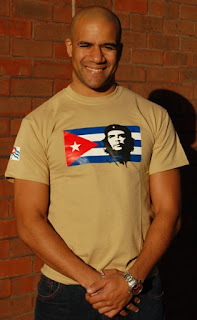 This t-shirt is available in Small, Medium, Large, X-Large and XX-Large.
Che Flag T-Shirt

Books about Ernesto ‘Che’ Guevara


In this touchingly affectionate book, Aleida March – Ché’s second wife – recalls a revolutionary romance tragically cut short by Ché’s execution in Bolivia by CIA-backed troops. From a young “girl from the sticks” hopelessly addicted to romantic fiction, Aleida joins the guerrilla struggle against Batista before falling in love with iconic revolutionary hero Ernesto ‘Ché’ Guevara.
Aleida – with tremendous passion and poignancy – conjures a remarkable picture of a remarkable man. Unlike most literature surrounding the subject, the book gives a truly unique insight into Ché’s personality and touching humour. Like all of us, he is a flawed human being, but he is underpinned by steely determination and selfless dedication.
It also gives the first detailed impression of the life and role of Aleida March herself. Her strength and courage is exemplified – not just by her role bringing up four children with an absent father – but the crucial part she played establishing and developing the Federation of Cuban Women (FMC) which is now the biggest NGO in the whole of Latin America.
Buy it now from our online shop
Who Killed Che? How the CIA got away with murder
This book presents fascinating new evidence which joins the dots between the role of the Bolivian armed forces and the CIA in the events leading to Che Guevara’s murder on 9th October 1967, nearly 24 hours after his capture.

The CIA began a file in July 1956, identifying “Che” as a key political figure and charted his movements from Cuba via the Congo to Bolivia. Despite their antipathy, Che’s personality and political qualities come through even these CIA files.
The account of Che’s capture is well documented but this book contains evidence of direct CIA involvement and places one of their agents at the scene of his murder consulting with the highest authorities in the administration. This is the “smoking gun” that puts them on the spot.
Buy it now from our online shop
Travelling with Che Guevara – The Making of a Revolutionary

In 1952, young doctor Alberto Granado, set off from Cordoba in Argentina and travelled through Chile, Peru, Colombia and Venezuela by motorbike, with him was a medical student named Ernesto Guevara.
Along the way they came across shocking levels of poverty and exploitation of the native population which had a massive effect on both men. This is the beginning of a tale in which Granado commits himself to medicine on his continent, and Ernesto becomes Che, Cuban revolutionary and Latin American hero.
Published for the first time in English, this partner to Che's Motorcycle Diaries is a moving and often hilarious story of how two carefree young men came of age and found their true purpose in life.
Buy it now from our online shop
Che in Verse
Complex and charismatic, Ernesto 'Che' Guevara has been immortalised in popular culture as the archetypal, self-sacrificing rebel with a cause. His martyr's death in October 1967 transformed him into the poster-boy of revolution - and also inspired poets and songwriters the world over to put pen to paper.
Che in Verse reproduces 134 of the finest poems and songs from 53 countries about or referring to this enigmatic Argentine-Cuban revolutionary. It examines how Che was celebrated or remembered from before his death at the hands of the CIA-backed Bolivian army to the present day. And it explores why Guevara - himself a gun-toting poet - has achieved a level of sanctification comparable to Christ.
Buy it now from our online shop
Complex and charismatic, Ernesto 'Che' Guevara has been immortalised in popular culture as the archetypal,
self-sacrificing rebel with a cause. His martyr's death in October 1967 transformed him into the poster-boy of revolution - and also inspired poets and songwriters the world over to put pen to paper.Che in Verse reproduces 134 of the finest poems and songs from 53 countries about or referring to this enigmatic Argentine-Cuban revolutionary. It examines how Che was celebrated or remembered from before his death at the hands of the CIA-backed Bolivian army to the present day. And it explores why Guevara - himself a gun-toting poet - has achieved a level of sanctification comparable to Christ.
Buy it now from our online shop
Books by Ernesto ‘Che’ Guevara
These diaries were written by Che during his 1952 motorcycle odyssey through Latin America with his friend Alberto Granado as Guevara is transformed and politicised by the injustice he witnesses.

During their travels, Guevara and Granado encounter the poverty of indigenous peasants: they witness a penniless couple forced onto the road because of their communist beliefs in Chile; the maltreatment of workers at a Chuquicamata copper mine; the segregation of dark-skinned peasants; and observe the division of society whilst volunteering on a leper colony in Peru. They also chase girls, drink too much and get into scrapes along the way – but it is the encounters with social injustice that help crystallise Guevara’s belief in egalitarianism and a pan-Latin American identity.
Had Guevara’s life not become entwined in revolutionary adventure, this would have been the journey of a lifetime. As the Times described it, the Motorcycle Diaries is “Easy Rider meets Das Kapital”.
Buy it now from our online shop
Latin America Diaries
This book is another riveting instalment of the life and times of Che Guevara as he travels Latin America and becomes increasingly involved in political struggles from 1953. It is a sequel to the Motorcycle Diaries and provides an enjoyable and fascinating look at the development of a revolutionary hero.

His second trip through the continent reveals the emergence of a revolutionary icon, captured in these writings - his diary entries, poetry, journalism and letters. Together they document his life after leaving medical school, travelling through Peru, Bolivia and Ecuador and his witnessing of the US-inspired coup in Guatemala before travelling to Mexico where he encounters Fidel Castro.
As a writer, Che had the ability bring to life sights, sounds, emotions; elicit feelings of romance, laughter, even tears. This book makes clear Che’s humour, passion for life and love of people.
Buy it now from our our online shop
Reminiscences of Cuban Revolutionary War
This autobiographical book by Che Guevara documents his experiences during the Cuban Revolution. First published in 1963, it was a compilation of articles by Che that originally appeared in Verde Olivo, the weekly publication of Cuba’s Revolutionary Armed Forces.

This collection of memories conveys the excitement, zeal, possibilities, problems and limitations of Guevara's "guerrilla warfare" strategy as it was practiced in the Sierra Maestra. It is brimming with battlefield action as it examines how the popular war transformed a nation and follows Che’s own transition from troop doctor to world famous revolutionary leader.
It features a preface by Che’s daughter, Aleida Guevara, and a new translation with Che’s own corrections incorporated into the text for the first time, this edition also contains extraordinary photographs of the period.
Buy it now from our online shop
Guerrilla Warfare
This classic account of the motivations and justifications of revolution forms the basis of Che’s theory of guerrilla warfare. It was written after the Cuban Revolution and soon became the guidebook for thousands of guerrilla fights in across the world. As well as being used as a manual for revolutionary struggle, it has been studied by counter-revolutionary military schools to inform counter-insurgency strategy.

Guevara stresses the need for an underpinning political motivation to guerrilla methods, organisation and supply. He emphasisez that guerrilla warfare is a favourable method only against totalitarian regimes where political opposition and civil struggle is impossible to conduct.
Guevara dedicated the book to his recently deceased comrade Camilo Cienfuegos, "who should have read and corrected it, but whose fate prevented him from carrying out the task."
With an introduction by Marc Becker, this is more than an instruction guide to founding a guerrilla movement, it is a work that sets out the faith necessary for political action, it showcases Che’s own idealism and gives the best insight into Guevarist political philosophy and military strategy.
Buy it now from our online shop
African Dream – Diaries of the Revolutionary War in the Congo
The African Dream follows Che’s attempts to spread the fight against U.S. imperialism to Africa. This extraordinary diary records in minute and often humorous detail Guevara’s experiences with a Cuban guerrilla force in the eastern Congo between April and November 1965. In his own opinion, the adventure was a fiasco and this book is an unvarnished account of what he saw as flaws in the Congolese revolutionaries he met and his own military strategy.

The differing splits and factions in the Congolese resistance characterises the ethnic in-fighting that has effected the whole world and, in particularly, this region of Africa. Che’s frustration at the lack of success with his task becomes obvious, but one must not diminish the importance of how much the Cubans learnt from their experiences in the Congo, in relation to their later international successes.
This special edition contains a beautiful foreword by Aleida Guevara March, the daughter of Che Guevara plus 8 pages of stunning photos.
Buy it now from our online shop
The Bolivian Diary
Che Guevara’s famous last diary – found in his backpack after he was captured by the Bolivian Army and assassinated by CIA-backed troops in 1967 – played a pivotal role in catapulting him to iconic status after his death.

This fascinating diary is the remarkable and ultimately tragic account of the Bolivian Liberation Army and Che’s attempts to forge a revolutionary movement of workers and peasants against the military dictatorship. The book is a sobering account of the drudgery, fear and monotony of guerrilla warfare. Much of the diary is taken up with the preoccupations of basic survival in primitive conditions. There are some wonderful moments, such as commandeering a jeep and running it on the urine of his guerrillas, but ultimately this period will be remembered for Che’s tragic death which enshrined him as a martyr of the radical Left.
Buy it now from our online shop
Che Guevara mug only £3.50

Our Che Guevara mug – designed exclusively for CSC – features the classic Che image, ‘Viva la Revolucíon Cubana!’ slogan, star and CSC website.
Red and black print on white mug. Dishwasher safe. And only £6.60 inc P&P from our online shop.
Although Che preferred a hot drink of mate, why not get a packet of delicious Cuban coffee to go with your designer mug?
Red and black print on white mug. Dishwasher safe. And only £6.60 inc P&P from our online shop.
Although Che preferred a hot drink of mate, why not get a packet of delicious Cuban coffee to go with your designer mug?
Wednesday, 29 August 2012
Films about Ernesto 'Che' Guevara
The Motorcycle Diaries
Che Part 1 & 2 - A Revolutionary Life
Buy it now from our online shop
The Motorcycle Diaries is the compelling biopic based on the memoirs of Ernesto ‘Che’ Guevara. The film recounts Che’s 1952 expedition across Latin America with his friend Alberto Granado as Guevara is transformed and politicised by the injustices he witnesses.
During their travels, Guevara and Granado encounter the poverty of indigenous peasants: they witness a penniless couple forced onto the road because of their communist beliefs in Chile; the maltreatment of workers at a Chuquicamata copper mine; the segregation of dark-skinned peasants; and observe the division of society whilst volunteering on a leper colony in Peru. These encounters with social injustice help crystallise Guevara’s belief in egalitarianism and a pan-Latin American identity.
The film expertly captures the adventure and humour of Che’s diary and Gael Garcia Bernal’s portrayal of Guevara’s political awakening – as he journeys from adolescent adventurer to Marxist revolutionary – is truly captivating.
In 2005 the Motorcycle Diaries won the BAFTA Film Award for Best Film not in the English Language.
Buy it now from our online shop
Che Part 1 & 2 - A Revolutionary Life
Spread over two explosive movies, Che: Part One and Part Two have gained fame for their unflinching, graphic and incredibly realistic depiction of guerrilla warfare.
Part One follows Guevara’s adventurous journey from his beginnings as a young, politically active physician to becoming one of the most iconic revolutionaries in Latin America. Meticulously re-enacting Che’s relentless quest to destroy the Batista dictatorship and bring freedom to Cuba, Part One marches towards an unforgettable, heart pounding, cinematic climax. Benicio del Toro’s depiction of Che is uncanny and – from his first meeting with Fidel Castro in the opening scene – the film gives tremendous insight into the Cuban revolution in terms of origins, philosophy and military tactics.
Part Two – in contrast – is a more sombre affair as Che journeys into the merciless terrain of the Bolivian jungle in an attempt to export revolution and build an international assault on imperialism. The insidious reach of America delves deep into the South American continent and – after being captured by CIA-backed troops – Che is unceremoniously executed.
Del Toro won the Best Actor Award at the Cannes Film Festival for his portrayal of Che with Cuban state newspaper Granma professing that he “personifies Che” in both his physical appearance and his “masterly interpretation”.
Buy it now from our online shop
Friday, 17 August 2012
"Neo-liberal policies are destroying my continent"
 |
| Aleida Guevara at the 2004 European Social Forum |
Aleida Guevara will tour the UK in September in a special ‘Remembering Che’ speaking tour organised by the Cuba Solidarity Campaign. Full details here.
The following article was written by Aleida for the Guardian in 2004.
The following article was written by Aleida for the Guardian in 2004.
It is extremely dangerous for humanity that the president of the mightiest power on the planet publicly says that he speaks with and acts on behalf of God. What lies ahead for us? More of what is happening today in Afghanistan or Iraq? Is that the future for our children? We need to pull all our strength together to avoid such a future.
Today, more than ever before, it is important that thousands of people are coming together to confront this situation and to look for ways to achieve a more just and equal world.
For me, it constitutes a big honour to represent my people at the European Social Forum in London this week. When I say "my people", I refer to my continent - to the Mandinga, Congo or Carabali blood that runs through my veins.
I also refer to the very wise Asian culture that is part and parcel of our own culture. I feel able to do this because I was educated to respect and accept other cultures even if I do not understand them in their totality. Since I was young, I have understood how right Benito Juárez, the outstanding Mexican patriot, was when he said: "Respecting others' rights is the way to peace."
Some time ago, I first visited Brazil. I felt a tight knot in my heart, and I mean that literally. I thought the pain I felt would not let me go on. To see children living in the poorest conditions, being used by unscrupulous people for prostitution and drug trafficking, all this really made me very angry - because Brazil is one of the richest countries in my continent, with as many natural resources as you can think of, with vast expanses of very fertile land, with enough cattle to feed the whole continent.
How can it be possible that there are people, especially children, who live or survive in these conditions? How can such a situation be tolerated?
There in Brazil, I thought that we humans must have a limit to our patience and that, somehow, we must decide whether it is better to starve to death or to die fighting in an attempt to change this reality. Then I thought that my way of thinking could be the result of my education in a socialist society, with a different cultural and professional level, and with a different ideology. But none of these things are important when your children are dying right in front of your eyes and no one is willing to extend a helping hand. It does not matter who you are, man or woman - you just cannot continue living like that.
Rosa, an ordinary Brazilian woman, showed me this. She not only said the same thing that I have said, but also put words into practice: she died defending a piece of land to feed her children. It is for mothers like Rosa that I raise my voice, and it is for Rosa and for many others that we have to move forward.
Neo-liberal policies are destroying my continent. We are now importers of grains, when we used to be major producers. But it happens that the grain we produce does not belong to us any longer.
We cannot go on like this. It is important that honest men and women in Europe awaken to the reality of the historical debt they have to our peoples.
It is only because of the wealth looted from our lands and our people that their present high standards of living are possible.
When will this be stopped? An urgent answer is needed. Time passes quickly and it may happen that, by the time we realise what we have lost, we will not even have a place to live.
We all need to live in a better world. Solidarity and unity are indispensable in these times. Let us do our best. It is likely that only humans can dream. I do not know. But what I know is that only we have the capacity to make our dreams come true.
A better world is possible. The challenge lies in being able to act, rather than just talk.
Tuesday, 14 August 2012
A revolutionary train of thought
 |
| El Tren Blindado - the armoured train |
The Battle of Santa Clara was a decisive victory for Fidel Castro’s revolutionary forces against the rule of General Fulgencio Batista. Within 12 hours of the city’s capture, Batista fled the island and the Cuban Revolution triumphed. Following two years of intense fighting, the dictator’s regime capitulated under popular pressure – but it was a train that helped achieve the final victory.
According to Comandante Ernesto ‘Ché’ Guevara – who led the assault on Santa Clara – the city had huge strategic importance because it was “the centre of the railroad system and all communications in the country”. If the revolutionaries could liberate Santa Clara, then the capital Havana would soon fall.
On paper, the attack looked suicidal. Ché’s rag-tag band of guerrillas – weary from constant skirmishes with federal forces – barely numbered 300. They faced an army garrison of 3,500 soldiers and a heavily armoured locomotive containing another 400 combatants. Los Barbudos – the bearded ones – were outnumbered and outgunned, but Batista’s troops were demoralised. In addition, a sympathetic local population supported the insurgents by building barricades to neutralise Batista’s tanks. This allowed the revolutionaries to embed themselves throughout the city.
Ché knew that success depended on nullifying the armoured train. After appropriating a bulldozer from the local agricultural college, Ché’s men removed 30 feet of track. As the locomotive approached from Capiro Hill, it was derailed and three carriages overturned. Government soldiers came tumbling out and a bloody battle ensued.
“Our Molotov cocktails forced the men out of the armoured train,” reflected Ché. Under constant fire, “the train became – thanks to its armoured plating – a veritable oven for the soldiers.” At 7pm on 30th December 1958, the train and its soldiers surrendered to the rebels.
 |
| Bulldozer used by Che |
The capture of the train proved a key tipping point in the revolution as news of the victory spread quickly round the island. It struck a psychological blow at the heart of Batista’s army who – already low on morale – were tired of fighting their own people. Furthermore, the bounty gained – including bazookas, machine guns, mortars, a 20mm cannon, 600 rifles and $4m worth of munitions – strengthened Fidel Castro’s rebel army and allowed them to equip student reinforcements and peasant supporters.
Rail-workers and the Cuban Revolution
If the Battle of Santa Clara was the spark for success, the foundations were laid through prolonged armed struggle and mass working class action – and rail-workers themselves played a crucial role in overthrowing the Batista dictatorship.
Rail-workers – like workers throughout Cuba – came under brutal attack from the Batista regime as mass redundancies and forced retirement were introduced, collective agreements were scrapped, the working-day was increased and wages were reduced by over 20%. Strikes were ruthlessly repressed as the army rounded-up train-workers and signalling staff and forced them to work at gunpoint.

This helped militarise the workforce – particularly in the East of the island. In 1955, railwayman Octavio Louit established a local branch of Fidel Castro’s 26th July Movement in Guantanamo. The clandestine cells derailed scab trains and organised short stoppages which helped disrupt timetables whilst reducing the risk of victimisation. When Fidel Castro’s band of guerrillas landed on the south coast in 1956, the Guantanamo rail-workers created a diversion with a spectacular strike as the whole rail network was paralysed in the east of Cuba for five days. Throughout the revolutionary struggle train crews supported the guerrillas by smuggling arms and ammunition.
The activity of rail-workers helped facilitate a general strike which – following the Battle of Santa Clara – consigned the Fulgencio Batista dictatorship to history.
The Footsteps of Ché
The capture of Santa Clara helped create the legend of Ché Guevara and confirmed his reputation as a military strategist. Today, the city is a shrine to the world’s most iconic revolutionary. The derailed train and bulldozer – elevated on cement plinths – remain on display as a permanent tribute to the famous victory. His image is emblazoned on walls throughout Santa Clara and – if you spend any time in the central square – you’ll meet someone claiming to have fought alongside the man himself and happy to regale you with revolutionary reminiscences.
Just outside town is the Ché museum and mausoleum. Following the repatriation of his remains in 1997, Ché is buried in the mausoleum alongside his rebel comrades. An imperious bronze statue stretches high into the sky and sits atop a fascinating museum charting Guevara’s journey from care-free student doctor to committed guerrilla fighter.
** SPECIAL OFFER ** Only £1,000 if you book and pay before Monday 20th August 2012
This autumn, to mark the 45th anniversary of Ché Guevara’s assassination by CIA-backed troops in Bolivia, an exclusive one-off brigade will visit Cuba to undertake solidarity work, spend time in Santa Clara and enjoy the island’s cultural delights.
The cost of the brigade includes return flights, Cuban tourist card, accommodation, food, and most visits.
This new study tour – based in Santa Clara, Trinidad and Viñales – will examine Ché’s involvement in the Cuban Revolution. There will also be visits to neighbourhood projects, schools and health care centres.
For further information and to book, please email tours@cuba-solidarity.org.uk or call the Cuba Solidarity Campaign on 020 8800 0155.
Thursday, 9 August 2012
Book Review: Remembering Ché – My Life With Che Guevara, Aleida March

In this touchingly affectionate book, Aleida March – Ché’s second wife – recalls a revolutionary romance tragically cut short by Ché’s execution in Bolivia by CIA-backed troops. From a young “girl from the sticks” hopelessly addicted to romantic fiction, Aleida joins the guerrilla struggle against Batista before falling in love with iconic revolutionary hero Ernesto ‘Ché’ Guevara.
Their first encounter – deep in the Escambray Mountains – involves Ché removing a secret package of supplies and money strapped to Aleida’s torso. Whilst Ché confessed he suspected her of being sent to “monitor him because of his reputation as a communist,” Aleida found Ché’s “penetrating gaze rather intriguing”. It is not long before Ché is serenading Aleida with poetry as they cavort through battlefields.
Aleida – with tremendous passion and poignancy – conjures a remarkable picture of a remarkable man. Unlike most literature surrounding the subject, the book gives a truly unique insight into Ché’s personality and touching humour. Like all of us, he is a flawed human being, but he is underpinned by steely determination and selfless dedication.
It also gives the first detailed impression of the life and role of Aleida March herself. Her strength and courage is exemplified – not just by her role bringing up four children with an absent father – but the crucial part she played establishing and developing the Federation of Cuban Women (FMC) which is now the biggest NGO in the whole of Latin America. No other organisation has done more to champion and advance the role of women in Cuban society. Furthermore, she succeeded in raising her family – according to the frugal ideals she shared with Ché – as ordinary Cubans. She went on to institute the Ché Guevara Studies Centre in Santa Clara and, to this day, remains its Director.
The book gives a fresh perspective on decisive historical events – such as the Battle of Santa Clara – and illustrates the qualities of Ché’s leadership. Correspondence between Ché and his family and between Ché and Fidel help deepen understanding of Ché’s revolutionary sojourns in the Congo and Bolivia. When Aleida’s narrative requires further clarification, helpful footnotes explain the historical significance.
Letters and poems sent between Ché and Aleida are peppered throughout the book and reveal Ché’s psychological state as he endeavours to export revolution. In a remarkable short story, The Stone, written in the Congo and reproduced in full here, Ché predicts: “I would decompose on the grass or they might exhibit me”. The precise foreshadow is truly chilling.
One hundred priceless photographs from family albums – many published here for the first time – illustrate the story and add further depth to our understanding of Ché. One particular photo shows Ché disguised as the balding “old uncle Ramón” with his four children in 1966. It tragically captures the last time Ché saw his beloved family.
As Ché once wrote: “At the risk of seeming ridiculous, the true revolutionary is guided by a great feeling of love. It is impossible to think of a genuine revolutionary lacking this quality.” This book provides an authentic insight into Ché’s love – for the world’s dispossessed, popular revolution and his treasured family.
Buy it now for just £12.99 from our Cuba Connect website
Che and Aleida’s daughter – Dr. Aleida Guevara March – will be touring the U.K. in September. Catch her at a venue near you - full details here
Friday, 9 September 2011
Che's Murderer and Operation Miracle
 |
| Che and Fidel |
Mario Terán, a retired noncom notorious for having executed the legendary guerrilla fighter Ernesto Che Guevara on Oct. 9, 1967, at a little school in La Higuera in Bolivia, lived in the deepest anonymity in Santa Cruz. Steeped in indigence, he lived on his miserly pension as a former soldier and had lost his sight to cataracts that he had been unable to cure, for lack of resources.
In 2004, Cuban President Fidel Castro launched a broad humanitarian campaign throughout the continent, named Operation Miracle. Supported by Venezuela, it consists in operating – at no personal cost – on those low-income Latin Americans who suffer from cataracts and other eye diseases. In 30 months, about 600,000 people from 28 countries, including U.S. citizens, recovered their eyesight thanks to the altruism of the Cuban doctors. The avowed objective is to operate 6 million people by 2016.
The election of Evo Morales as President of the Republic of Bolivia in December 2005 and his willingness to establish social policies that will improve the wellbeing of some of the poorest people in the continent have allowed Bolivians to gain access to the humanitarian program launched by Cuba. About 110,000 Bolivians have regained their eyesight without paying a single penny.
Among them is Mario Terán, who was rid of his serious illness by the Cuban doctors. Pablo Ortiz, a Bolivian journalist who works for the newspaper El Deber of Santa Cruz, told the story: "Terán had cataract problems and was cured in Operation Miracle by Cuban doctors at absolutely no cost."
Then he gave more details: "The fellow is a perfect unknown. Nobody knows who he is. He is destitute and when he appeared at the hospital hosting Operation Miracle nobody recognized him; he was then operated. The story came from his own son, who came to the newspaper to express his gratitude in public... It happened last August [2006]."
Sometimes, history keeps some surprises in reserve. Thus, the murderer of Che was cured by doctors sent by Fidel Castro, the most faithful and intimate companion of "the heroic guerrilla." Terán owes his eyesight to the emissaries of health that follow the internationalist example of the man he killed.
According to the former CIA agent Félix Rodríguez, who participated in Che's capture, Terán volunteered to execute the rebel leader. Earlier, he had murdered in cold blood all the other prisoners. But his valor failed when he faced Che.
"When I entered the classroom, Che was seated on a bench. When he saw me, he said: 'You've come to kill me.' I felt inhibited and lowered my head without answering.
"Then he asked me: 'What did the others say?' I told him they had said nothing, and he commented: 'There were brave men!'
"I didn't dare to shoot. At that moment, I saw a big Che, very big, enormous. His eyes shone with intensity. I felt that he was overwhelming me and when he looked at me fixedly I felt woozy. I thought that, if he moved quickly, Che could take away my weapon.
"'Stay calm and aim carefully,' he told me. 'You are going to kill a man.'
"I took a step backward, toward the door, closed my eyes and fired the first burst... I regained my composure and fired the second burst, which struck him in an arm, a shoulder and the heart. He was already dead."
Che, despite the execrable media campaign designed to stain the image of one of the greatest revolutionaries of the 20th Century, remains "big, very big, enormous" and continues to shine "with intensity" thanks to the sacrifice of tens of thousands of Cuban doctors who, from the anonymity of their heroic action everywhere, continue to believe that another, less cruel world is possible.
Article by Salim Lamrani
Monday, 14 March 2011
Alberto Granado's message to the Cuba Solidarity Campaign
In 2008, CSC's CubaSi magazine carried an exclusive interview with Alberto Grenado, where he talked about his trip with Che Guevara and recorded this message of greetings and and thanks to the members of CSC in the UK for their work in solidarity with Cuba. Alberto was Che's friend from university, and travelling companion on his motorcycle trip around Latin America. He died peacefully of natural causes in Cuba aged 88 in March 2011.
Sunday, 6 March 2011
Alberto Granado dies in Cuba

Alberto Granado, Che's friend from university, and travelling companion on his motorcycle trip around Latin America, has died peacefully of natural causes in Cuba aged 88.
Alberto was an advisor to the 2004, Walter Sallas film about the trip which stared Gael Garcia Bernal, and Alberto also appears at the end of the film. He also wrote his own book about the journey, Travelling with Che, which gives his view of the adverture and political awakening of the two young Argentinians.
In 2008, CSC's CubaSi magazine carried an exclusive interview with Alberto, where he talked about this trip, and sent a message of greetings and and thanks to the members of CSC in the UK for their work in solidarity with Cuba.
The full CubaSi interview by Steve Ludlam of Sheffield CSC (pictured with Alberto, left) is reprinted here.
Subscribe to:
Posts (Atom)