Thursday, 15 December 2011

Alberto Juantorena visits Hackney school ahead of the London 2012 Olympics

Alberto Juantorena, Cuban world champion middle distance runner and Vice President of INDER, the Cuban Institute of Sport, visited Hackney on a pre-Olympic visit. He made a special visit to meet with children at Grasmere Primary School on Albion Road, in Newington Green.

Children watched a video of Juantorenna winning the 800 metres Gold medal at the 1976 Olympics in Montreal. Then, after a few questions from an awestruck, audience the runner produced the actual gold medal from his pocket. He then visited a few of the classes to talk some more to the students. Alberto’s key message was repeated a number of times when he said:

“to achieve something like this Olympic gold you need three things discipline, dedication and passion”

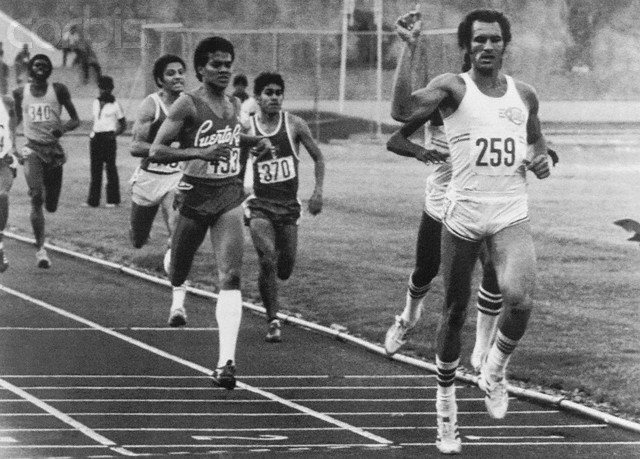
At the 1976 Summer Olympics, Juantorena became the first and so far only athlete to win both the 400m and 800m Olympic titles setting world records at both events.   With his famous sprint and his unique middle distance combination he seemed to have heralded a new era and style for middle-distance runners. In the 1970’s Juantorena was often referred to as ‘White Lightening’ or ‘El Caballo’ (the horse).

Current UK Olympic chief Sebastian Coe is a friend and admirer of Juantorena. In 1979 Sebastian Coe finally broke Juantorena’s 800m record which he had held for 3 years.

"I remember seeing him in Montreal and thinking, 'I'm in the wrong distance.' This was a record that was sensational." - Sebastian Coe

Juantorena is one of the most prominent Cuban sporting figures and travels the world in his role as a council member of the International Athletics Federation (IAAF). He has always maintained the highest standards in support of athletics and sports in general and is a great exponent of the Cuban sports ethos.

“We want to promote the great qualities of athletics - and maintain its integrity - all over the world.”

Wednesday, 14 December 2011

Alberto Juantorena maintains his belief in the Cuban way

Juantorena wins the 400m gold at the 1976 Olympics
He's a legend of the five-ringed circus, but money still can't buy Alberto Juantorena, writes Rick Broadbent in the Times and the Australian

Alberto Juantorena, who won two gold medals at the 1976 Olympics, recently visited a London school where a child asked how much his medals were worth. The man they call El Caballo (The Horse) didn't know. Nobody had asked him the question before. Perhaps that is Britain's problem.

As London gets its head around an pound stg. 81 million ($125m) budget for the Olympic opening and closing ceremonies, it is fascinating to sit with a product of the Cuban revolution, who won the 400m and 800m titles in Montreal. It's trite to term Juantorena simply an Olympic legend; this imposing figure is also a part-time politician and paid-up visionary who says he knows the secret of success.

"Chess," he declares, the voice of suave ribaldry fading to a whisper. "You know the spirit and heart of chess in my country?" he asks. "Che Guevara."

A mural of the revolutionary is above us on the wall of a cluttered office belonging to the Cuba Solidarity Campaign in London.

"He was the promoter of chess in my country, and knew that it helped a student look for a solution. It teaches you how to think, so chess is a sport we implant into minds. It's taught from primary school to university. It's essential."

State-sponsored board games seem a leap of faith from the 1976 Montreal Olympics, when Juantorena completed the "impossible" double of 400m and 800m, and yet his faith in the Cuban system is unassailable.

His blueprint for success taps into debates about Xbox motivations and 2012 legacies.

"The reason we are so successful is because we focus on children," he says. "In primary school they are taught physical education three times a week. We have 2.5 million students practising this. It's the system combined with the intelligence of the people. That's why we have 78,000 PE teachers. That's why we are a small country which wins medals."

In Cuba this took a revolution; London will have to make do with a two-week knees-up. Juantorena, now an ursine 61, paints a rosy red picture of communist Cuba and believes it punches above its weight because it values sport properly. Thank Fidel Castro for that.

"When I came home from Montreal in 1976 I was the first to descend the plane," he says. "Fidel was there. We embraced. We talked of many things and I realised he was a 100 metres runner. He told me he won in the 1946 inter-college competition. He said, 'I had a long stride, like you'.

"Fidel was the philosopher who created sport in my country. After the revolution, it did not matter what race, religion or gender you were, you had the opportunity to practise sport."

Juantorena left Castro at the airport and went back to work.

"I volunteered to pick coffee, cut sugar cane and plant vegetables," he says. "I did that for two weeks. My medals did not belong to me. Other athletes dedicated medals to their families; I dedicated mine to the anniversary of the Moncada Garrison because they gave Cuba freedom."

His success in Montreal is unlikely to be repeated. He was a 400m specialist recovering from two operations on his foot until his Polish coach, Zygmunt Zabier-zowski, had a brainwave.

"'One day,' he said, 'you will run the 800 in the next Olympics' and I jumped as high as Javier Sotomayor (the Olympic high jump champion). I was afraid. I thought I'd be too tired. I'd lose everything. But he tried me with the long-distance runners. They tried to kill me and they couldn't. So he put me in a race in Italy. It was the first time I'd run 800m in my life and I ran 1min 45.76sec."

He is grinning widely now. "I went to the Olympics and became the only man in history to run on every day of the athletics program. They changed the schedule for me and started calling me El Caballo the horse."

Commentator David Coleman went further. "The big Cuban opened his legs and showed his class," he said, thus starting an industry in commentating gaffes.

American rival Rick Wohlhuter had said that Juantorena would be unable to cope with the 800m rounds, but his classy three-metre stride resulted in magic as well as mirth and he set a world record. "My coach said that because of my 400 speed, a first lap of 50 seconds would be like walking. I hung back and hung back. Wohlhuter was crazy. He went on the outside and so ran 820 metres. In the last 20 metres (Belgian) Ivo Van Damme got the silver."

An unspectacular qualification for the 400m final exhumed double doubts. "I was in the lane two. That's the second killing lane, but I had an advantage because I could see them all. I was so confident. I was not running but floating and then, boom, in the last 50 I killed them all."

Thus an Olympic hero was created. He became a celebrity and yet remained humble, even when taking on roles such as vice-president of INDER, the Cuban sports institute that once set up 31 sports centres in the Escambray Mountains because Castro felt the remote region was a source of untapped potential.

Juantorena does not accept many interviews and his patriotism may appear one-eyed in the wake of numerous defections.

The country's leading baseball team, Industriales, has struggled this season after seven players fled the country. Add five National Ballet dancers and a star soccer player, who shimmied down a hotel fire escape in North Carolina, and it's clear that the monthly government salary the equivalent of $US16 does not suit all. Olympic champions fare better with a lifetime monthly stipend of $US300, but can Castro's ideals survive the modern age?

"It is not a big problem but it becomes big propaganda," Juantorena says. "The press say Cubans are running from the system because they are oppressed, because they kill people, because they put people in jail, but this is bullshit. I feel sorry for them. The socialist system gave me all possibilities and all they asked was that I stayed loyal and said thank you."

Britain has a former Cuban triple jumper in its track team. Yamile Aldama's story is complex, but she competed for Sudan after leaving Cuba with her Scottish husband. Now she has a British passport and was fifth at the world championships, one of the so-called "plastic Brits".

"I know her very well," Juantorena says. "She decided to abandon Cuba and went to this place and that place. It's her own decision. I am strongly against the trafficking of athletes who change country from one day to the next. They are selling themselves as merchandise. The real person, the real human being who loves their country, believes in something and never changes their allegiance. You have to be honest and follow your dignity. Now you see some guy and he is not able to even sing the national anthem."

Cuba dropped from fifth in the Olympic medals table in 1992 to 28th by 2008 but Juantorena insists defections do not add up to a defect in the system. It is just increasingly hard to compete.

When the country's biggest athletics star, hurdler Dayron Robles, was disqualified from the gold medal position at the world championships, he said that it was because he came from Cuba. Juantorena rejected any conspiracy theories but said he agreed.

Whether Cuba can continue to punch above its weight in London remains to be seen, but El Caballo is convinced. "This system works," he said. "You cannot go through sport or life motivated only by money."

He plays with his gold medal; the other is in a museum in Havana for the people. Even in a five-ring circus, with cynics pointing to its budget as proof that the Olympics are more corporate carve-up than sporting carnival, some things cannot be bought.

Wednesday, 7 December 2011

‘We prepare athletes for sport – and life’

President Raul Castro with 2008 Cuban Olympic team
Morning Star sports editor Greg Leedham talks to Cuban ex-110m hurdler Emilio Valle and Cuban junior athletics coach Alfredo Dijhigo. From today's Morning Star.

Emilio Valle and Alfredo Dijhigo attract a lot of attention on an otherwise uneventful and very blustery autumn afternoon as I take them to see the Olympic Stadium in Stratford.

Walking along the Greenway path that straddles the site, Valle, a successful 110 metres hurdler who narrowly missed out on a medal at the Atlanta Olympics, and Dijhigo, a coach with Cuba’s junior athletics team, are quickly swamped by local teenagers keen to know more about these two men whose colourful Cuban national team uniforms cut through the dreariness of the weather.

The scene is the kind that Olympic organisers dream of — role model athletes inspiring and engaging local children. The pair, visiting London on a cultural and athletics exchange organised by Maurice Sharp of the Hercules Wimbledon Athletics Club, are worthy of the hype.

Valle and Dijhigo work with Cuba’s young athletes from the ages of 14 to 19, preparing them for hopefully successful careers with the senior team. It is a tough job — both earn around $30 a month and they struggle with equipment shortages due to the US blockade of their country, but they stay remarkably upbeat nonetheless.

This is partly due to the fact that, with Dijhigo aged 53 and Valle 44, the blockade has been in place before they were born. It is a way of life, just as struggle against great odds is a part of the Cuban experience.

The Special Period following the collapse of the Soviet Union also ushered in an age of acute austerity even by Cuban standards. Scrimping on sporting equipment was a necessity yet the Caribbean island still thrived on the Olympic stage.

Rigorous planning and ingenuity in making meagre funds go far has been essential to their success, explains Dijhigo back at the Morning Star offices.

“For us discipline is very important,” he says. “It’s possible that we don’t have the same economy as other countries, where development may be better. But the intention and the way we see life — it is the same.”

The willingness of former Cuban athletes to give back to the system that created them is also key. “He (Emilio) was my student, one of my athletes,” Dijhigo explains.

“When he was working in a physical education he was my athlete. Now we are working together as coaches. I gave him my experience. Now he must pass on his experience. We must transmit our experience and we cannot break the chain.”

A few Cuban athletes, such as flyweight boxer Yuriorkis Gamboa who won gold at Athens 2004, have broken that chain by defecting to the United States.

Dijhigo is phlegmatic about those who leave, though he laments that the country’s youth will no longer be able to benefit from their experience.

“If some athletes want to go professional — OK, no problem,” he says. “Only we never stop working. We never stop preparing athletes.”

He expands on his philosophy. “Sport is like the discipline of life. If you obey the discipline of life you can be, you can do better, you can offer more. You can offer more and also you cannot be selfish — it is not only for you.

“You should be grateful to the ancestor, the people who came before you, who give to you all that you received, and now you are offering.”

Cuba have won 194 medals in total at summer Olympics, with 100 of these coming in boxing and athletics. The country is broadening its horizons though, Dijhigo explains, despite incredible logistical issues when it comes to acquiring equipment.

“In cycling, we are getting better. But the bicycles we want to buy are from the United States, which is very close,” he explains. “But we have to buy from another place. We cannot buy from Mexico as the companies are owned by the US companies. We have to, for example, get a Jamaican to go to Mexico and buy a bicycle and bring it to Cuba after going back through Jamaica.

“We have one bicycle for every two or three athletes — a direct effect of the blockade.”

Such struggle would provoke bitterness in many, but not in Dijhigo nor Valle, whose joviality transcends his lack of English.

Valle competed against the likes of Britain’s Colin Jackson in his heyday — and has fond memories of competing at the top in an event in which Cuba now has the Olympic champion in Dayron Robles.

“I competed against athletes from many countries, but we were all friends,” Valle recalls fondly. “We may have a different system or way of life, but we would talk, be friends, no problem.”

As the duo depart, I am told that part of the schedule for their short trip is to take some training sessions with athletes from Sharp’s club and it reminds me of Dijhigo’s earlier remark, “We not only prepare athletes but a person who can be a good person in society.”

Valle and Dijhigo’s actions show that these are not mere words.

Wednesday, 30 November 2011

Alberto Juantorena to visit UK


Alberto Juantorena, Cuban world champion middle distance runner and Vice President of INDER, the Cuban Institute of Sport, will be coming to the UK as a guest of the Cuba Solidarity Campaign. He will be attending a number of events and meetings around that time with a focus on parliament and the upcoming London Olympics.
At the 1976 Summer Olympics, Juantorena became the first and so far only athlete to win both the 400 and 800m Olympic titles setting world records at both events.   With his famous sprint and his unique middle distance combination he seemed to have heralded a new era and style for middle distance runners. In the 1970’s Juantorena was often referred to as ‘White Lightening’ or ‘El Caballo’ (the horse).
Current UK Olympic chief Sebastian Coe is a friend and admirer of Juantorena and they ran against each other on a number of occasions in the late 1970s.  In 1979 Sebastian Coe finally broke Juantorena’s 800m record

"I remember seeing him in Montreal and thinking, 'I'm in the wrong distance.' This was a record that was sensational." - Sebastian Coe
With the 2012 London Olympics fast approaching his visit is a timely reminder of the strength of Cuban sporting achievement, reflecting the open participatory nature of sport and culture within Cuban society.
Juantorena is one of the most prominent of Cuban sporting figures and travels the world in his role as a council member of the International Athletics Federation (IAAF). He has always maintained the highest standards in support of athletics and sports in general and is a great exponent of the Cuban sports ethos.

“We want to promote the great qualities of athletics - and maintain its integrity - all over the world.”
Juantorena will be one of the special guest speakers at the Latin America Conference on December 3rd at Congress House. He will speak alongside three of the mothers of the Miami Five as well as over 50 speakers from Latin America and Cuba.

Juantorena's visit is a real opportunity for people to hear first hand from this true great of world athletics

For media enquiries and hi-res photos contact Cuba Solidarity Campaign via telephone 0208 800 0155 or email

Watch Juantorena discuss the 800m with Sebastian Coe, Wilson Kipketer, and David Rudisha


Watch Juantorena win the 800m at 1976 Olympic games

Wednesday, 9 November 2011

Latin America Conference 2011

This year's Latin America Conference will feature special guests from Cuba including Alberto Juantorena - former Olympic gold medalist - and mothers of the Miami 5.

Tickets available from the Cuba Solidarity Campaign via telephone (020 8800 0155) or online.

Please join the Facebook Event to stay up-to-date with speakers. Full details can also be found here.

Vigil for the Miami Five

Please start mobilising for this Vigil today. Bring candles, flags and trade union banners.

Full details and Facebook group here. Full list of speakers here.

Tuesday, 1 November 2011

How the U.S. is preparing a "Cuban Spring"


Felice Gorordo, who has worked in the White House, is one of the founders of Roots of Hope.
The organisation is part of Washington's latest offensive against Cuba
Haitians have repeatedly witnessed how Washington carries out “regime change” in the past two decades. In the lead-up and aftermath of the 1991 and 2004 coups, we saw how the U.S. concocted organizations like the Democratic Convergence and Group of 184 through the National Endowment for Democracy (NED) and the Central Intelligence Agency (CIA). U.S. subversion has succeeded twice in Haiti, but it has failed miserably dozens of times in our neighbor Cuba. Let’s look at the most recent destabilization campaign they are cooking up for our Cuban brothers and sisters.

The U.S. government has been trying to snuff out the Cuban revolution for over 50 years. Through multiple attacks by the CIA, it has tried everything, but the Cuban revolution continues on its socialist path, benefitting not only the Cuban people but other peoples of the world – with doctors, soldiers, and technicians – thanks to Cuba’s revolutionary internationalism.

Now, the U.S. is trying to take advantage of popular struggles, like those in the Arab world, against the very governments which it used to support. These struggles are often led by the large, educated young generation of 15 to 30-year-olds. Using this model, the U.S. wants to prepare Cuba’s youth for a counter-revolution. By working through a Cuban-American organization called “Roots of Hope” – "Raíces de Esperanza" in Spanish – U.S. officials dream of organizing a "Cuban spring."

Roots of Hope was launched in 2003 by a group of idealistic young Cuban-Americans. Their website says: "We are a network of more than 3,000 students and young professionals across the U.S. and abroad focused on empowering Cuban youth. We seek to inspire young people to care about Cuba, think outside the box and proactively support our young counterparts on the island through innovative means. In 2003, we were founded by college students as an association between the Georgetown and Harvard Cuban American student groups. Today, we encompass a dynamic and diverse group of young servant leaders throughout the U.S. with students at more than 55 universities and young professionals in Boston, New York, Washington, D.C., Los Angeles, Chicago and Miami. We hope to make a positive impact on Cuba."

One of the main projects of Roots of Hope is to send cellphones to Cuban youth to “help them connect with each other.” It has also established a fund to promote travel to Cuba by young Cuban-Americans.

According to its leaders, the organization is apolitical, with members having very different views on U.S. policy toward Cuba. Since its founding in 2003, Roots of Hope has sponsored academic forums at Harvard, Georgetown, Princeton, Duke and the University of Pennsylvania, through a network of over 2,000 students, young professionals and graduates, representing more than 87 schools and 28 affiliated organizations.

They define their mission as "empowering youth to become authors of their own future." Their vision:
A day when Cuban youth are empowered with the necessary skills and opportunities to make a successful future for themselves and their families in Cuba. A day when youth on the island can freely participate in open exchanges about their ideas, hopes, dreams, and realities. A day when Cuban youth can freely say, think, feel, or do what they want and not what they're told – without repression. When Cuban youth in and outside of the island can be reunited.
Is this what is called apolitical? Isn’t the political message loud, clear and concrete?

One of the founders of Roots of Hope is Felice Gorordo. He is a White House employee in the White House Fellows program. As the White House’s website explains:
Founded in 1964, the White House Fellows program is one of America's most prestigious programs for leadership and public service. White House Fellowships offer exceptional young men and women first-hand experience working at the highest levels of the federal government.
Gorordo works in the Office of Public Engagement and Intergovernmental Affairs at the White House. He also worked with the George W. Bush administration’s Cuba Transition Coordinator, Caleb McCarry, who was responsible for defending U.S. interests in Cuba and promoting the Cuban revolution’s destruction.

Another founding member of Roots of Hope is Tony Jimenez. He said the group is nonpartisan, that the organization works hard to stay above the political fray regarding Cuba.

However, Roots of Hope is an organization of the reactionary right, supported by the Cuban Democratic Directorate, and the Cuban American Legislators, two virulently anti-Cuban-Revolution organizations based in Florida.

So here we have an organization which purports to not support or endorse any political group or candidate, and to be apolitical. Is it due to this complete lie that many young people in the United States have innocently joined it, unaware of the truth? This organization, which claims to work for the unity of young Cubans, creating a link between young people in Cuba and the United States, is a rising force which the enemies of the Cuban revolution have concocted to destabilize Cuba. Its real role is to assist the struggle of U.S. imperialism against Cuba. They aim to, as their website says to “use new media to promote positive social change in the U.S. and Cuba.” Of course, Roots of Hope did not choose other ways to help young Cubans, like, say, Pastors for Peace, which brought busloads of medicine and medical equipment. Instead, Roots of Hope sends Cuba cellular telephones so it can try to corrupt young people with counter-revolutionary text messages and voice mails.

How can this organization, which claims to be apolitical, be linked to and working in solidarity with  the infamous “Ladies in White” (Las Damas de Blanco) and support the arch-reactionary blogger Yoani Sánchez. Who’s fooling whom?

In fact, the work of Roots of Hope is not much different from that done by the accomplished international terrorist Orlando Bosch Avila and his criminal organization, of which the terrorist Luis Posada Carriles is an influential member. On their site, Roots of Hope even sends a solidarity message to the Ladies in White, employed by the CIA: "You sent a strong message of support to those who struggle for human rights and nonviolent change in Cuba. With this momentum, together let’s take the next steps to make an impact on the island and empower those who hunger for change in Cuba!"

And who funds Roots of Hope? In addition to the U.S. government, Roots of Hope is sponsored by Bacardi Rum, Liberty Power, Hispanic Magazine, Navarro Discount Pharmacy, and a host of other counter-revolutionary companies.

On Sep. 21, a Haïti Liberté reporter attended a fundraising activity organized at the Chelsea Art Museum in Manhattan for Roots of Hope and another organization called "100 Cameras." At the event, one of the organizers clearly stated that, in Cuba, people are already wearing Roots of Hope T-shirts, and they are clear about the organization’s counter-revolutionary goal.

Roots of Hope also attended the Conservative Political Action Conference (CPAC) which took place on Sep. 23 in Orlando, Florida. During this conference, Roots of Hope was part of a panel entitled "Paralyzed by communism: Freedom of expression in Cuba."

The organization "100 Cameras" is no different that its sister, Roots of Hope, and this explains why the two groups closely work and fundraise together. We need not speculate, we need only visit the "100 Cameras" website to understand their mission and purpose. Here is what Francine Angela Bullock, their Public Relations Director, writes there:
Why Cuba? ... The island remains the world’s longest lasting socialist government. And right now, Cubans face limited possibilities restricted by their own government. And these limitations tend to create a climate of fear that discourages creativity, innovation, and entrepreneurship... We knew that during this time of significant political change between Cuba and other parts of the world, we could provide the opportunity to see Cuba through the eyes of a child... Without any political agenda. It would be the children’s raw perspective that would raise awareness and funds! We knew that if 100cameras had the opportunity to empower these children, then we could empower the grassroots efforts for positive social change within their communities. And ultimately, even the entire island... And we asked ourselves instead, “Why NOT Cuba?” Besides, a project like this has never been successfully done before within Cuba... Help us empower the Cuban youth through the voice of photography.
In short, these two organizations – Roots of Hope and 100 Cameras – are trying to use technology to promote social conflicts, especially in Cuba, since they failed to do so by acts of terrorism and above all by the economic blockade. Imperialism is coopting the techniques pioneered by the popular uprisings against their client regimes in Egypt and Tunisia.

For sure, the U.S. government will continue its efforts to destabilize the Cuban socialist system, even though their attempts to destroy the Cuban Revolution have always failed. Now they are working at the base, going to young people, even children, in an effort to corrupt them to create a new generation of men and women who can become imperialism’s agents and try to return Cuba to being the U.S.’s whorehouse.

Fortunately, the Cuban people are organized, conscious, and alert. Let us Haitians continue to show our solidarity with the Cuban people, the same way Cuba has always provided solidarity to us.

This article was written for Haiti Liberte by Mona Peralte